How Your Brain Predicts Reality [Prof. Karl Friston]

About
No channel description available.
![Abstraction & Idealization: AI's Plato Problem [Mazviita Chirimuuta]](https://imgz.pc97.com/?width=500&fit=cover&image=https://i.ytimg.com/vi/yq318DIwPqw/hqdefault.jpg)
![Why Every Brain Metaphor in History Has Been Wrong [SPECIAL EDITION]](https://imgz.pc97.com/?width=500&fit=cover&image=https://i.ytimg.com/vi/pO0WZsN8Oiw/hqdefault.jpg)
![AutoGrad Changed Everything (Not Transformers) [Dr. Jeff Beck]](https://imgz.pc97.com/?width=500&fit=cover&image=https://i.ytimg.com/vi/9suqiofCiwM/hqdefault.jpg)
![Why Scientists Can't Rebuild a Polaroid Camera [César Hidalgo]](https://imgz.pc97.com/?width=500&fit=cover&image=https://i.ytimg.com/vi/vzpFOJRteeI/hqdefault.jpg)
Video Description
To truly understand natural intelligence and address complex issues like mental well-being, we must first be able to build it ourselves. We met our hero, the brilliant neuroscientist Professor Karl Friston. We explore Professor Friston's life's work, the Free Energy Principle, and what it reveals about life, intelligence, and consciousness itself. **SPONSORS** Gemini CLI is an open-source AI agent that brings the power of Gemini directly into your terminal - https://github.com/google-gemini/gemini-cli --- Take the Prolific human data survey - https://www.prolific.com/humandatasurvey?utm_source=mlst and be the first to see the results and benchmark their practices against the wider community! --- cyber•Fund https://cyber.fund/?utm_source=mlst is a founder-led investment firm accelerating the cybernetic economy Oct SF conference - https://dagihouse.com/?utm_source=mlst - Joscha Bach keynoting(!) + OAI, Anthropic, NVDA,++ Hiring a SF VC Principal: https://talent.cyber.fund/companies/cyber-fund-2/jobs/57674170-ai-investment-principal#content?utm_source=mlst Submit investment deck: https://cyber.fund/contact?utm_source=mlst *** They kick things off by looking back on the 20-year journey of the Free Energy Principle. Professor Friston explains it as a fundamental rule for survival: all living things, from a single cell to a human being, are constantly trying to make sense of the world and reduce unpredictability. It’s this drive to minimize surprise that allows things to exist and maintain their structure. This leads to a bigger question: What does it truly mean to be "intelligent"? The group debates whether intelligence is everywhere, even in a virus or a plant, or if it requires a certain level of complexity. Professor Friston introduces the idea of different "kinds" of things, suggesting that creatures like us, who can model themselves and think about the future, possess a unique and "strange" kind of agency that sets us apart. From intelligence, the discussion naturally flows to the even trickier concept of consciousness. Is it the same as intelligence? Professor Friston argues they are different. He explains that consciousness might emerge from deep, layered self-awareness—not just acting, but understanding that you are the one causing your actions and thinking about your place in the world. They also explore intelligence at different sizes. Is a corporation intelligent? What about the entire planet? Professor Friston suggests there might be a "Goldilocks zone" for intelligence. It doesn't seem to exist at the super-tiny atomic level or at the massive scale of planets and solar systems, but thrives in the complex middle-ground where we live. Finally, they tackle one of the most pressing topics of our time: Can we build a truly conscious AI? Professor Friston shares his doubts about whether our current computers are capable of a feat like that. He suggests that genuine consciousness might require a different kind of "mortal" computation, where the machine's physical body and its "mind" are inseparable, much like in biological creatures. TRANSCRIPT: https://app.rescript.info/public/share/FZkF8BO7HMt9aFfu2_q69WGT_ZbYZ1VVkC6RtU3eeOI TOC: [00:00:00] Introduction & Retrospective on the Free Energy Principle [00:09:34] Strange Particles, Agency, and Consciousness [00:37:45] The Scale of Intelligence: From Viruses to the Biosphere [01:01:35] Modelling, Boundaries, and Practical Application [01:21:12] Conclusion REFS: Inner Screen [Fields] https://arxiv.org/abs/2305.02205 Genius [Gleick] https://www.amazon.com/Genius-Life-Science-Richard-Feynman/dp/0679747044 Epistemic foraging [Bengio] https://youtu.be/G1ARvwQntAU?feature=shared Being You [Seth] https://www.penguin.co.uk/books/111089/being-you-by-seth-anil/9780571337729 Predictive Mind [Hohwy] https://global.oup.com/academic/product/the-predictive-mind-9780199682737 Hidden Spring [Solms] https://www.amazon.com/Hidden-Spring-Journey-Source-Consciousness/dp/0393542017 M-Autonomy [Metzinger] https://www.ingentaconnect.com/content/imp/jcs/2015/00000022/f0020011/art00013 Chinese Room [Searle] https://plato.stanford.edu/entries/chinese-room/ Mortal computation [Hinton] https://www.cs.toronto.edu/~hinton/ Intelligence [Krakauer] https://www.santafe.edu/people/profile/david-krakauer Plant predictive processing [Calvo/Friston] https://royalsocietypublishing.org/doi/10.1098/rsif.2017.0096 Basal cognition [Levin] https://scholar.google.com/citations?user=luouyakAAAAJ&hl=en Computational boundedness [Wolfram] https://writings.stephenwolfram.com/2023/12/observer-theory Extended mind [Clark/Chalmers] https://tinyurl.com/yy8xbwnm FEP synchrony [Ramstead] https://www.youtube.com/watch?v=jsIt2sTB_vo Markov blankets [Beck] https://arxiv.org/abs/2502.21217 Object-centric priors [Tenenbaum] https://arxiv.org/abs/1612.00341 Free-energy principle [Friston] https://www.nature.com/articles/nrn2787 Path Integrals [Friston et al.] https://arxiv.org/abs/2210.12761

![Why High Benchmark Scores Don’t Mean Better AI [SPONSORED]](https://imgz.pc97.com/?width=500&fit=cover&image=https://i.ytimg.com/vi/rqiC9a2z8Io/hqdefault.jpg)
![The Mathematical Foundations of Intelligence [Professor Yi Ma]](https://imgz.pc97.com/?width=500&fit=cover&image=https://i.ytimg.com/vi/QWidx8cYVRs/hqdefault.jpg)
![Tensor Logic "Unifies" AI Paradigms [Pedro Domingos]](https://imgz.pc97.com/?width=500&fit=cover&image=https://i.ytimg.com/vi/4APMGvicmxY/hqdefault.jpg)
![He Co-Invented the Transformer. Now: Continuous Thought Machines [Llion Jones / Luke Darlow]](https://imgz.pc97.com/?width=500&fit=cover&image=https://i.ytimg.com/vi/DtePicx_kFY/hqdefault.jpg)


![We Built Calculators Because We're STUPID! [Prof. David Krakauer]](https://imgz.pc97.com/?width=500&fit=cover&image=https://i.ytimg.com/vi/dY46YsGWMIc/hqdefault.jpg)
![Why Humans Are Still Powering AI [Sponsored] - Phelim Bradley](https://imgz.pc97.com/?width=500&fit=cover&image=https://i.ytimg.com/vi/R11ESdfVX64/hqdefault.jpg)
![The Universal Hierarchy of Life - Prof. Chris Kempes [SFI]](https://imgz.pc97.com/?width=500&fit=cover&image=https://i.ytimg.com/vi/iwClZ-7OweY/hqdefault.jpg)
![Google Researcher Shows Life "Emerges From Code" [Blaise Agüera y Arcas]](https://imgz.pc97.com/?width=500&fit=cover&image=https://i.ytimg.com/vi/rMSEqJ_4EBk/hqdefault.jpg)
![AI training data will never be fully synthetic [SPONSORED]](https://imgz.pc97.com/?width=500&fit=cover&image=https://i.ytimg.com/vi/cnxZZTl1tkk/hqdefault.jpg)
![AI Agents can write 10,000 lines of hacking code in seconds [Dr. Ilia Shumailov]](https://imgz.pc97.com/?width=500&fit=cover&image=https://i.ytimg.com/vi/aoX_pGQMbEM/hqdefault.jpg)
Neuroscience Learning Essentials
AI-recommended products based on this video
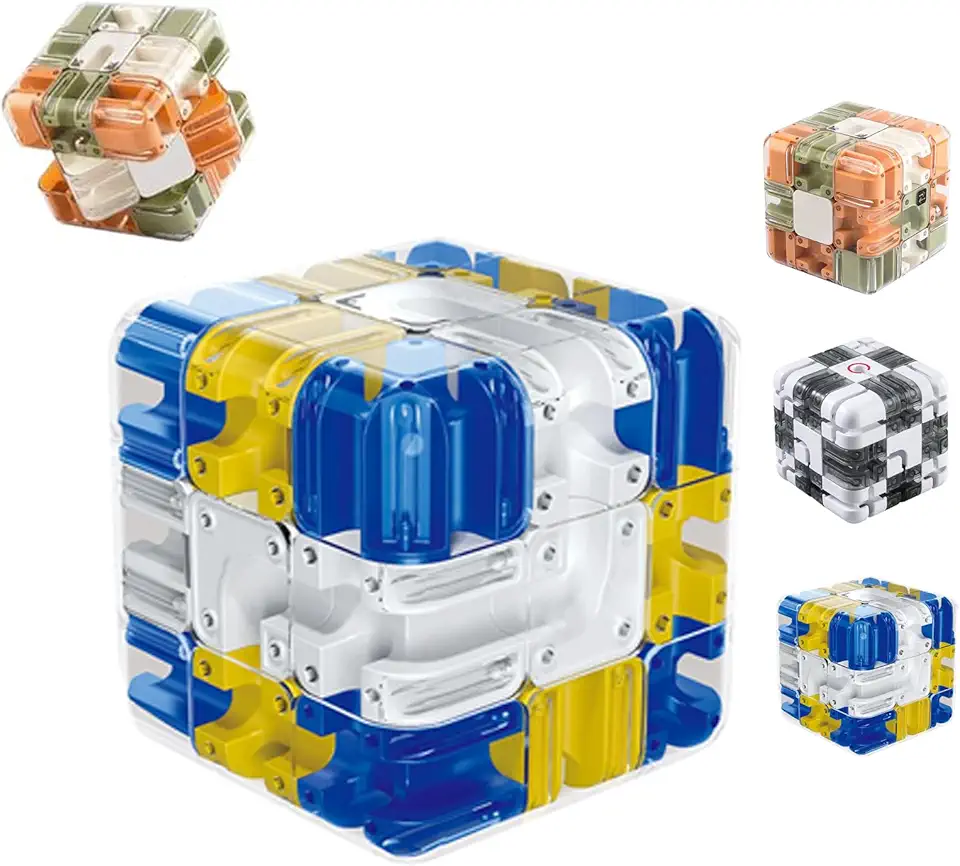
Large Labyrinth 3D Puzzles Maze Cube with Rolling Ball, Challenging Brain Teaser Puzzles for Adults & Kids, High-Difficulty Cube Logic Game for Spatial Awareness Focus Training Stress Relief (Blue)

Cat Scratch Deterrent Spray, Cat Repellent Spray Indoor and Outdoor for Cat and Kitten, No Scratch Spray Training Aid for Furniture, Sofas, Curtains - Non-Toxic, Alcohol-Free Formula 120ML

Crovakeu Professional Lock Pick Set - 1-Piece Compact Locksmith Tools Kit with Practice Locks for Beginners & Pros - Portable Lockpicking Tools for Fidget, Stress Relief & Skill Training