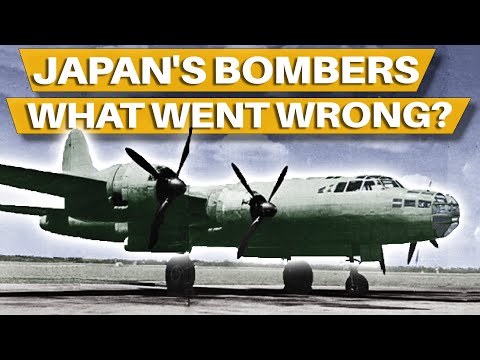
Mistake or Calculated Risk? Why Japan Did Not Build Strategic Bombers

Military Aviation History
@militaryaviationhistoryAbout
Christoph Bergs: Does airpower, likes archives, prefers cockpits over lounge chairs. - Associate at Freeman Air and Space Institute, King's College London. - Official Partner of USNIP and Mortons Books. Exclusive discounts / coupons / vouchers: Naval Institute Press: 25% off with "MILAVHIS" at https://www.usni.org/press/books Mortons: 10% off with "MAH10" at https://www.mortonsbooks.co.uk/
Latest Posts


Video Description
Why did Japan not build Strategic bombers? The better question is, did they need them? - Naval Institute Press: 25% off with "MILAVHIS" https://www.usni.org/press/books Check out my books - Ju 87 Stuka - http://stukabook.com - STG-44 Assault Platoon - http://sturmzug.com - German Panzer Company 1941 - http://www.hdv470-7.com/ - Achtung Panzer? Zur Panzerwaffe der Wehrmacht - http://panzerkonferenz.de/ Support - Patreon: https://www.patreon.com/join/MilAvHistory - Channel Memberships: https://www.youtube.com/channel/UCmpahmxWXajV0-tuMMzSzAg/join - PayPal: https://www.paypal.me/MilAvHis Partner Discounts - Naval Institute Press: 25% off with "MILAVHIS" https://www.usni.org/press/books Social Media - Twitter: https://twitter.com/MilAvHistory - Instagram: https://www.instagram.com/milaviationhistory/ Bibliography/Sources Agawa, Hiroyuki. The Reluctant Admiral: Yamamoto and the Imperial Navy. Trans. John Bester. Tokyo: Kodansha International, 1979. Domoto-Eleftheriou, Kiri and George Eleftheriou. Arawasi Eagle Eye Series, No. 3: Mitsubishi Ki-21 “Sally” and Fiat BR.20 “Cicogna. Drea, Edward J. Japan’s Imperial Army: Its Rise and Fall, 1853-1945. Lawrence: University Press of Kansas, 2009. Evans, David C. and Mark R. Peattie. Kaigun: Strategy, Tactics, and Technology in the Imperial Japanese Navy, 1887-1941. Annapolis: Naval Institute Press, 1997. Ferkl, Martin. Mitsubishi G4M Betty. Ostrava: Revi Publications, 2002. Francillon, René J. Japanese Aircraft of the Pacific War. 2nd edition. London: Putnam Books, 1979. Goodwin, Mike and Peter Starkings. Japanese Aero-Engines, 1910-1945. Sandomierz: MMP Books, 2017. Melzer, Jürgen P. Wings for the Rising Sun: A Transnational History of Japanese Aviation. Cambridge: Harvard University Press, 2020. Mikesh, Robert C. and Shorzoe Abe. Japanese Aircraft, 1910-1941. Annapolis: Naval Institute Press, 1990. Peattie, Mark R. Sunburst: The Rise of Japanese Naval Air Power, 1909-1941. Annapolis: Naval Institute Press, 2001. Tagaya, Osamu. Osprey Combat Aircraft 22: Mitsubishi Type 1 Rikko ‘Betty’ Units of World War 2. Oxford: Osprey Publishing, 2001. Yokoyama, Hisayuki. “Air Operational Leadership in the Southern Front: Imperial Army Aviation’s trial to be an ‘air force’ in the Malaya offensive air operation.” In British and Japanese Military Leadership in the Far Eastern War, 1941-1945. Ed. Brian Bond and Kyoichi Tachikawa. New York: Routledge, 2004. Email correspondence with historian Osamu Tagaya. March 11-29, 2025. Timecodes 00:00 - Axis 4-Engine Bombers 02:27 - Japanese 4-Engine Bombers 05:36 - Japan gets the Junkers G.38/K.51 10:57 - Type 92 Heavy Bomber (Ki-20) 13:18 - Policy Changes 16:29 - G5N Shinzan 20:46 - G8N Renzan 22:51 - Naval Institute Press 23:50 - Ki-91 25:04 - G10N 26:52 - Japan: Early and Late 28:45 - Did Japan even need a Heavy Bomber? 31:54 - Japanese Navy Heavy Bomber 36:01 - Inoue Shigeyoshi (IJNAS) 41:51 - Japanese Army Heavy Bomber 44:20 - Sugawara Michio (IJAAS) 48:39 - Army Malaya Campaign 53:30 - Opportunity Cost of Heavy Bombers 58:31 - Why no Heavy Bombers Audio Music and Sfx from Epidemic Sound
Essential Aviation History Resources
AI-recommended products based on this video

Babies Around the World Eating: A Fun Book about Diversity that Takes Tots on a Multicultural Trip to Discover Yummy Food Around the World
