Op-Amps - Using Operational Amplifiers

DroneBot Workshop
View ChannelAbout
Welcome to the Workshop! The DroneBot Workshop is the place where I work with Arduino, Raspberry Pi, ESP32, and lots of other cool microcontrollers, components, and sensors. This is a channel for learning and understanding. While I do build projects, most episodes focus on showing you HOW things work, so you can use the information to bring your own designs to life. Every video has a corresponding article on my website at https://dronebotworkshop.com , along with the diagrams and code samples you’ll need to build your own creations. You can also participate in discussions on my Forum at https://forum.dronebotworkshop.com. Please note that I no longer do any sponsored videos, enquiries for these will be ignored! If you'd like to know more about me or the DroneBot Workshop you can read the FAQ at https://dronebotworkshop.com/about-dronebot-workshop/faq/ And if you have technical questions please ask them on the Forum. Welcome to the Workshop! I hope you enjoy your stay! Bill
Latest Posts


Video Description
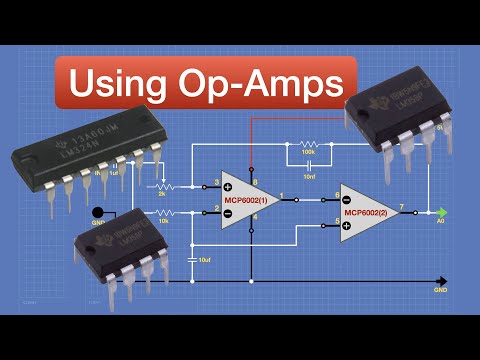
Op-amps are like analog building blocks; you can create almost anything with them. Today, we’ll learn how to use these versatile components, alone and with an Arduino. Article with code: https://dronebotworkshop.com/op-amp More articles and tutorials: https://dronebotworkshop.com Join the conversation on the forum: https://forum.dronebotworkshop.com Subscribe to the newsletter and stay in touch: https://dronebotworkshop.com/subscribe/ Operational Amplifiers, or “op-amps,” were initially designed for use in analog computers back in the 1940s. In fact, the “operational” in the name is a reference to the op-amp's ability to perform mathematical operations on voltages, which is how analog computers represent numbers. Op-amps have been available in integrated circuit (IC) format for nearly 60 years and have become a vital component in analog electronic design. There are two reasons for their popularity: 1 - They are versatile - Op-amps can be configured into dozens of basic circuits. 2 - They are inexpensive - Op-amps are pretty cheap! One of the devices we will look at today costs about 10 cents per op-amp. You can also use operational amplifiers to “glue” analog and digital electronics; in fact, one of the demos today uses an op-amp with an Arduino. Aside from that, we’ll also learn how op-amps work, how to configure them into several basic “analog building block” circuits, how to build a light-sensitive switch using them, and how to turn a single power supply into a dual one using an op-amp. Here is the Table of Contents for today's video: 00:00 - Introduction 02:20 - Operational Amplifiers 12:14 - Popular Op-Amps 16:17 - Op Amp Basic Circuits Hookup 18:32 - Voltage Follower (Buffer) 21:03 - Inverting Amplifier 22:36 - Non-Inverting Amplifier 24:06 - Low-Pass Filter 25:53 - High-Pass Filter 27:33 - Square & Triangle Wave Generator 29:22 - Op Amps with Arduino 34:58 - Light-Sensitive Switch 38:00 - Single to Dual Power Supply 42:13 - Conclusion One other thing to note is that “classic” components, like op-amps, didn’t seem to be affected by the global chip shortage. One more reason to consider using them in your designs! Hope you enjoy the video. Bill
Master Op-Amps with These Essentials
AI-recommended products based on this video

DAYBETTER LED Strip Lights 130ft Lights Strip for Bedroom, Desk, Indoor Room Bedroom Brithday Gifts RGB Decor with Remote and 24V Power Supply
