The Subtle Reason Taylor Series Work | Smooth vs. Analytic Functions

Morphocular
@morphocularAbout
The name rhymes with "binocular", and it's a channel intended to teach math with the help of visuals and animation wherever possible. Henri Poincaré once said about mathematicians, "Matter does not engage their attention, they are interested in form alone." And in one sense, math can be defined as the study of pure form ("morphḗ"). This channel is meant to be a morphocular, a lens on math, that clarifies and illuminates its often confusing and daunting concepts to reveal the beautiful thing it really is. I hope this channel lets a little of that beauty shine through to you. Note about business inquiries: The channel is currently in a less active state for the time being and so I have less energy to investigate sponsorship opportunities. Inquiries are still welcome, but I may not respond.
Latest Posts



Video Description
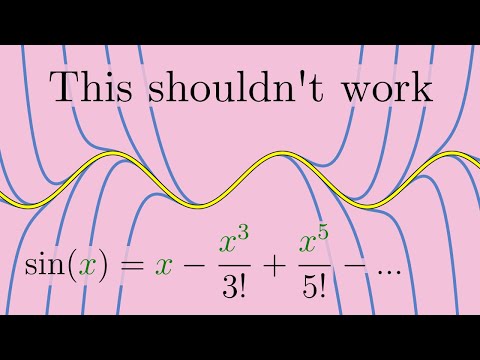
Get Surfshark VPN at https://surfshark.deals/MORPHOCULAR and enter promo code MORPHOCULAR for a Holiday Special offer of 5 extra months for free with the Surfshark One package. Taylor series are an incredibly powerful tool for representing, analyzing, and computing many important mathematical functions like sine, cosine, exponentials, and so on, but in many ways, Taylor series really shouldn't work as well as they do, and there are functions out there that can't be represented with them. What are these functions? And what's so special about so many of our familiar functions that we can compute them with Taylor series? =Chapters= 0:00 - How to calculate e^x 4:16 - Surfshark ad 5:15 - Why Taylor series shouldn't work 6:54 - A pathological function 8:25 - Taylor's Theorem 10:48 - Analytic functions vs. smooth functions 12:53 - The simplicity of complex functions 14:10 - The uses of non-analytic smooth functions 14:53 - See you next time! =============================== This video was generously supported in part by these patrons on Patreon: Marshall Harrison, Michael OConnor, Mfriend. =============================== CREDITS The music tracks used in this video are (in order of first appearance): Icelandic Arpeggios, Checkmate, Ascending, Rubix Cube, Orient The track "Rubix Cube" comes courtesy of Audionautix.com =============================== The animations in this video were mostly made with a homemade Python library called "Morpho". It's mostly a personal project, but if you want to play with it, you can find it here: https://github.com/morpho-matters/morpholib
You May Also Like


Math Enthusiast's Essential Tools
AI-recommended products based on this video
Texas Instruments BA II Plus Financial Calculator, Black
Texas Instruments BA II Plus Financial Calculator, Black

OSLINE Arts and Crafts for Kids Age 3-10,Gifts for 4-6-8 Year Old Girls Boys Toys,Toys for 5 6 7 Year Old,DIY Rainbow Scratch Paper Art Notebooks Kits for Kids,kids Christmas Birthday Gifts Age 7-12