Dendrites: Why Biological Neurons Are Deep Neural Networks


Artem Kirsanov
@artemkirsanovAbout
Exploring how neural systems learn and compute — at the intersection of neuroscience, computer science, and mathematics. Created by a Harvard neuroscience researcher.
Latest Posts


Video Description
Keep exploring at http://brilliant.org/ArtemKirsanov/ Get started for free, and hurry—the first 200 people get 20% off an annual premium subscription. My name is Artem, I'm a computational neuroscience student and researcher. In this video we will see why individual neurons essentially function like deep convolutional neural networks, equipped with insane information processing capabilities as well as some of the physiological mechanisms, that account for such computational complexity. Patreon: https://www.patreon.com/artemkirsanov Twitter: https://twitter.com/ArtemKRSV OUTLINE: 00:00 Introduction 01:42 - Perceptrons 03:43 - Electrical excitability and action potential 07:12 - Cable theory: passive dendrites 09:03 - Active dendritic properties 12:10 - Human neurons as XOR gates 19:11 - Single neurons as deep neural networks 22:32 - Brilliant 23:57 - Recap and outro Special thanks to Crimson Ghoul for providing English subtitles! REFERENCES (in no particular order): 1. Bicknell, B. A., Bicknell, B. A. & Häusser, M. A synaptic learning rule for exploiting nonlinear dendritic computation. Neuron (2021) doi:10.1016/j.neuron.2021.09.044. 2. Matthew Larkum. Are dendrites conceptually useful? Neuroscience (2022) doi:10.1016/j.neuroscience.2022.03.008. 3. Polsky, A., Mel, B. W. & Schiller, J. Computational subunits in thin dendrites of pyramidal cells. Nature Neuroscience 7, 621–627 (2004). 4. Tran-Van-Minh, A. et al. Contribution of sublinear and supralinear dendritic integration to neuronal computations. Frontiers in Cellular Neuroscience 9, 67–67 (2015). 5. Gidon, A. et al. Dendritic action potentials and computation in human layer 2/3 cortical neurons. Science 367, 83–87 (2020). 6. London, M. & Häusser, M. DENDRITIC COMPUTATION. Annu. Rev. Neurosci. 28, 503–532 (2005). 7. Branco, T., Clark, B. A. & Häusser, M. Dendritic Discrimination of Temporal Input Sequences in Cortical Neurons. Science 329, 1671–1675 (2010). 8. Stuart, G. J. & Spruston, N. Dendritic integration: 60 years of progress. Nat Neurosci 18, 1713–1721 (2015). 9. Smith, S. L., Smith, I. T., Branco, T. & Häusser, M. Dendritic spikes enhance stimulus selectivity in cortical neurons in vivo. Nature 503, 115–120 (2013). 10. Beniaguev, D., Segev, I. & London, M. Single cortical neurons as deep artificial neural networks. Neuron 109, (2021). 11. Michalikova, M., Remme, M. W. H., Schmitz, D., Schreiber, S. & Kempter, R. Spikelets in pyramidal neurons: generating mechanisms, distinguishing properties, and functional implications. Reviews in the Neurosciences 31, 101–119 (2019). 12. Larkum, M. E., Wu, J., Duverdin, S. A. & Gidon, A. The Guide to Dendritic Spikes of the Mammalian Cortex In Vitro and In Vivo. Neuroscience 489, 15–33 (2022). CREDITS: Icons by https://biorender.com Brain 3D models were modeled with Blender software using publicly available BrainGlobe atlases (https://brainglobe.info/atlas-api) This video was sponsored by Brilliant
You May Also Like







Neuroscience Learning Kit
AI-recommended products based on this video

140W C to Magnetic 3 Charger, Compatible with MacBook Air 13, 15 Inch/Mac Book Pro 14, 16 Inch, M1/M2/M3/M4 from 2021/2022/2023/2024/2025 Models, 6.6FT【Original Quality】
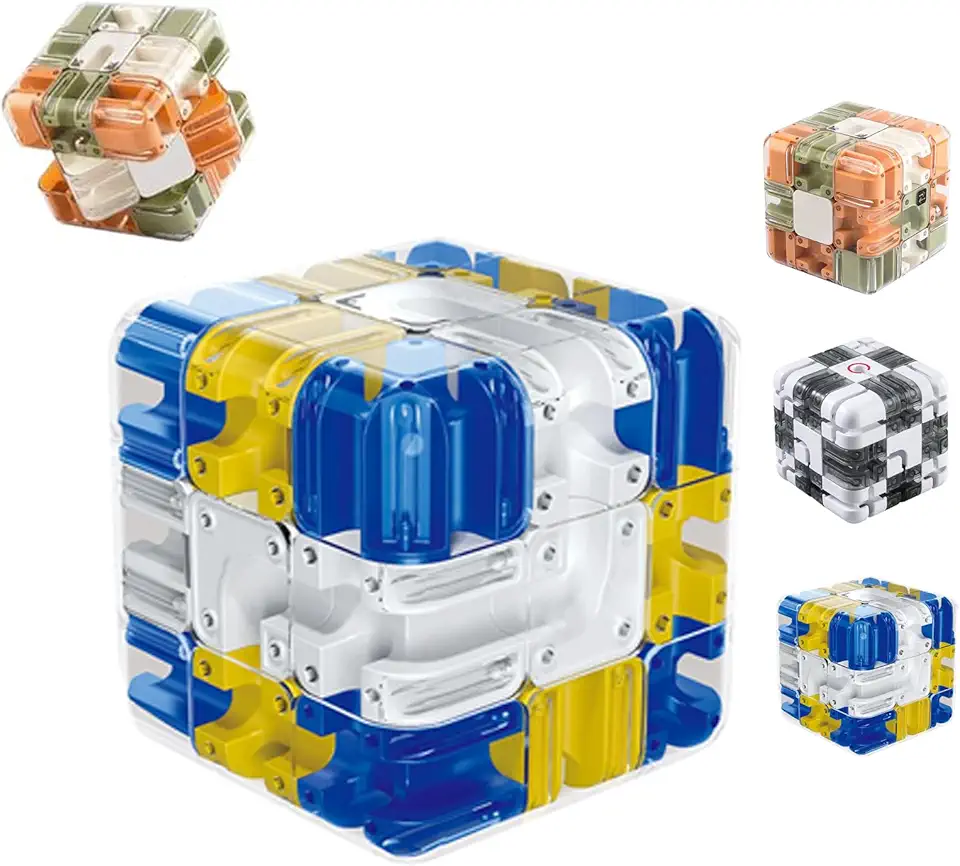
Large Labyrinth 3D Puzzles Maze Cube with Rolling Ball, Challenging Brain Teaser Puzzles for Adults & Kids, High-Difficulty Cube Logic Game for Spatial Awareness Focus Training Stress Relief (Blue)

Easter Gifts For Kids: Easter I Spy Search & Find for Kids Ages 3-7: Cute Spring Puzzles, Hidden Objects and Brain Games – Screen-Free Fun, Easter Basket Stuffers and Family Activities