NASA Finally Shows What's Inside Jupiter's Great Red Spot

The Secrets of the Universe
@thesecretsoftheuniverseAbout
Our Universe, explained from quarks to quasars! For collaboration and promotional inquiries, contact: [email protected]


Video Description
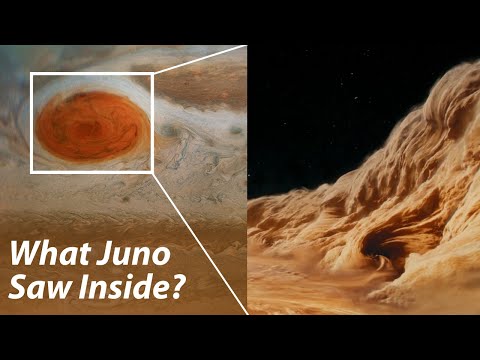
Ask 10 Doubts, Win 15 days Unacademy Subscription for FREE, Use my code SECRET to Unlock for FREE! AAD_CLASS 6: https://unacademy.onelink.me/k7y7/e3a1fd3c AAD_CLASS 7: https://unacademy.onelink.me/k7y7/7e303610 AAD_CLASS 8: https://unacademy.onelink.me/k7y7/4e42ce2d AAD_CLASS 9: https://unacademy.onelink.me/k7y7/44ea67ba AAD_CLASS 10: https://unacademy.onelink.me/k7y7/d608f4c3 AAD_CLASS 11: https://unacademy.onelink.me/k7y7/f5432e76 AAD_CLASS 12: https://unacademy.onelink.me/k7y7/5eabbe1b Link to emerge: https://unacademy.onelink.me/bosH/a42a9435 When it comes to Jupiter, how can one miss the mighty great red spot? The largest planet in the solar system hosts the biggest and the most violent storm known to date. We don't really know for how long it has been there on Jupiter, but it has been raging since Robert Hooke first discovered it through his telescope back in 1664. Over the years, several missions have explored this mighty storm on Jupiter. During their brief flybys, space probes such as Voyager 1, Voyager 2, and the Cassini spacecraft studied it. From Earth, the Hubble space telescope has been making observations of Jupiter and the Great Red Spot. Recently, data from Hubble suggested that the spot is shrinking. The storm was once big enough to engulf three Earth-sized planets inside it. Today, it can fit just over one Earth-sized planet. Not only that, the storm has sped up over the last decade. Hubble's data from 2008 to 2020 showed that the wind speeds at the edges of the Great Red Spot have increased by 8%. The anticyclone has also changed its shape, going from oval to circular. Making detailed observations of Jupiter from Earth is challenging. To really see what's happening inside the storm, we need to visit Jupiter and make continuous observations. And this is exactly what NASA's Juno spacecraft has been doing. Juno was launched in 2011 and reached Jupiter five years later. It has been orbiting the planet and continuously exploring Jupiter's magnetosphere, cloud tops, radiation belts, and the composition of its moons. Now, after collecting 5 years of data, NASA's Juno spacecraft has finally revealed what's happening inside the Great Red Spot.




No Recommendations Found
No products were found for the selected channel.