Ramanujan's easiest hard infinity monster (Mathologer Masterclass)


Mathologer
@mathologerAbout
Enter the world of the Mathologer for really accessible explanations of hard and beautiful math(s). In real life the Mathologer is a math(s) professor at Monash University in Melbourne, Australia and goes by the name of Burkard Polster. These days Marty Ross another math(s) professor, great friend and collaborator for over 20 years also plays a huge role behind the scenes, honing the math(s) and the video scripts with Burkard. And there are Tristan Tillij and Eddie Price who complete the Mathologer team, tirelessly proofreading and critiquing the scripts and providing lots of original ideas. If you like Mathologer, also check out years worth of free original maths resources on Burkard and Marty's site http://www.qedcat.com.
Latest Posts


Video Description
In this masterclass video we'll dive into the mind of the mathematical genius Srinivasa Ramanujan. The focus will be on rediscovering one of his most beautiful identities. 00:00 Intro 02:48 How did his mind work? 09:12 What IS this? 15:11 Fantastic fraction 18:12 Impossible identity 23:38 Thanks! This video was inspired by two 2020 blog posts by John Baez: https://math.ucr.edu/home/baez/ramanujan/ Here are some links to selected Mathologer videos dealing with Ramanujan's mathematics: Numberphile v. Math: the truth about 1+2+3+...=-1/12: https://youtu.be/YuIIjLr6vUA How did Ramanujan solve the STRAND puzzle? https://youtu.be/V2BybLCmUzs Ramanujan's infinite root and its crazy cousins: https://youtu.be/leFep9yt3JY Check out the article "Inequalities related to the error function" by Omran Kouba for the nitty gritties about Ramanujan's infinite fraction: https://arxiv.org/abs/math/0607694v1 Further discussion of the error function: https://tinyurl.com/mu5vywsz Another interesting stack exchange discussion: https://math.stackexchange.com/questions/1090857/bizarre-continued-fraction-of-ramanujan-but-wheres-the-proof Survey of the problems that Ramanujan submitted to the Journal of the Indian Mathematical Society. See page 29 for a discussion of the identity that we talk about in this video. Also of interest in the problem discussed on page 30: https://faculty.math.illinois.edu/~berndt/jims.ps This is the letter that Ramanujan sent to Hardy. Identity VII 6 is closely related to what we are talking about in this video https://www.qedcat.com/misc/ramanujans_letter.jpg The answer to Ramanujan's challenge appeared in the February 1916 issue of the Indian Mathematical society (vol. VIII, no. 1, pp. 17–20) "Answer to Problem 541 by K.B. Madhava". A couple of links and remarks about the "square root of the Wallis product": Wiki page for the Wallis product: https://en.wikipedia.org/wiki/Wallis_product (among other things check out the discussion on the value of the derivative of the Riemann zeta function at 0 at the end of this page). Mathologer video "Euler's infinite pi formula generator" has a proof for the Wallis product https://youtu.be/WL_Yzbo1ha4?t=465 Discussion on stackexchange of the asymptotic behaviour of the "square root" https://tinyurl.com/3yxyhjmp Also check out the discussion in A. De Morgan, "On the summation of divergent series", The Assurance Magazine, and the Journal of the Institute of Actuaries, 12 (1865), pp. 245--252. Here is a connection to the discussion of ways of associating meaningful values to certain divergent series in the Mathologer videos on 1+2+3+ "=" -1/12: log (the product) "=" - log 1 + log 2 - log 3 + log 4 - log 5 + log 6 - ... = log 2 - log 3 + log 4 - log 5 + .... and the last divergent series is known to have Cesaro sum log (pi/2)^(1/2). (essentially due to Euler, I think). See also exercise 207, page 515, in Knopp's book "Theorie and Anwendung der unendlichen Reihen", 2nd edition, Springer, 1924. Obviously, in the last part of the video, when we plug x=0 into the infinite fraction, we just go for it a la Nike: "Just do it", (or a la Ramanujan: 1+.2+3+...=-1/12). Having said that, us ending up with root pi over 2 which is exactly what we want, is really too weird a number to pop up by coincidence. As I said in the video, to really pin down why our manipulations give the right answers is tricky. For example, we need a justification for the way I arrive at the 1/1/2/3/4... fraction in the first place. Usually infinite fractions are evaluated by first turning them into a sequence of partial fractions. Then the value of the infinite fraction, if it exists, is the limit of this sequence. The partial fractions result by truncating the infinite fraction at the plus signs. For many infinite fractions you get a different sequence having the the same limit by truncating at the fractions bars instead. A very good book on infinite fractions featuring, among many other things, the Wallis product and the error function: Sergey Khrushchev, Orthogonal polynomials and continued fractions, Cambridge University press, 2008 (p.198, has a high-level proof for our infinite fraction in x rep. of the error function.) Bug report: 1. At some point I copied and pasted the warm-up infinite series instead of Ramanujan's infinite series.22:42 2. Almost invisible: An "(x)" is hiding in Ramanujan's hair :) at https://youtu.be/6iTdNmDHfV0?t=913 T-shirt: I bought today's t-shirt many years ago. When I just looked online I could not find it anymore. However, there are many similar designs available. Just google "Paranormal distribution". Music: Down the Valley by Muted The infinity sign turning into two question marks animation is based on an illustration entitled "Infinitely Many Questions" by Roberto Fernandez. See page 76 of my book Eye Twisters. Enjoy! Burkard








Master Math Tools Today
AI-recommended products based on this video
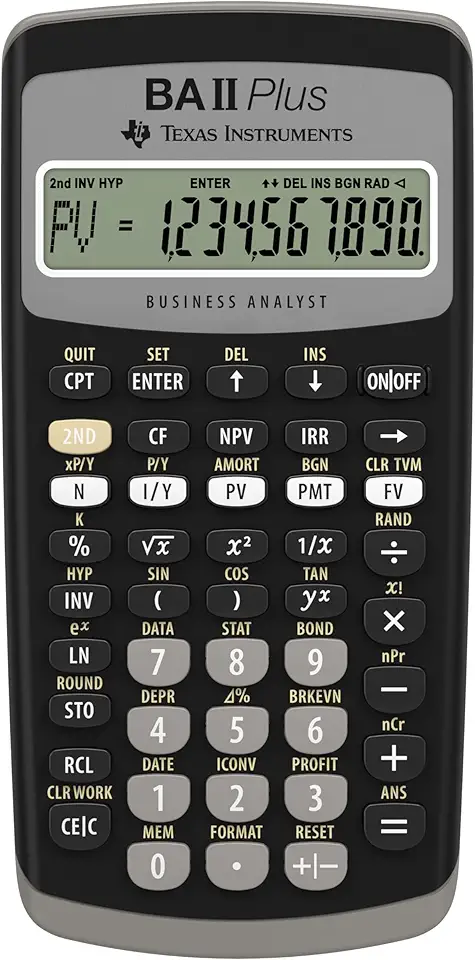
Texas Instruments BA II Plus Financial Calculator, Black
Teeth Whitening Strips for Tooth White: Professional Dentist Formulated Teeth Whitener Enamel-Safe Non-Slip 28 Strips 14 Treatments Mint (14 count (Pack of 1), Lemon Mint)

Art Kit, 272 Pack Art Set Drawing Kit for Kids Girls Boys, Deluxe Gift Art Supplies with Trifold Easel, Origami Paper, Coloring Pad, Sketch Pad, Pastels, Crayons, Pencils, Watercolors (Pink)
