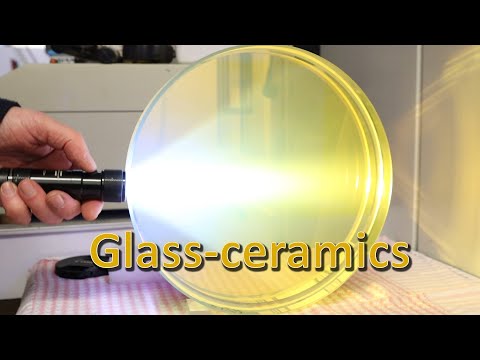
The Amazing Properties of Glass-Ceramics (GC Part 1)

Huygens Optics
@huygensopticsAbout
Hi, my name is Jeroen and on the Huygens Optics channel I publish videos on personal projects. My main fields of interest are optics, mechanics and photolithography. The videos aren't targeted towards a general audience but for people with a passion for science and technology (e.g. my fellow nerds). The channel is named after the famous Dutch mathematician, astronomer and inventor Christiaan Huygens (1629-1695). He was the first to publish a mathematical description of the wave properties of light, and also discovered Saturn's rings. I make these videos for fun, without a financial motivation. Please don't contact me for sponsoring contracts or in-video advertisement. Neither me nor my viewers are interested. If you want to contribute as a viewer, you can do so by either donating using the Paypal link or by using the Patreon account: https://www.patreon.com/huygens_optics Your donation helps me to make better videos.
Latest Posts


Video Description
The video discusses how the property of "zero-expansion" is achieved in glass-ceramics. 00:00 Intro 01:10 The discovery of glass-ceramics at Coning 02:12 Thermal shock exeriments 06:46 Coefficient of thermal expansion explained 10:12 Measuring CTE if glasses and glass-ceramics (experiment) 14:05 CTE measurement results 17:11 creating negative and zero CTE 20:17 Crystallization and nucleation 22:25 How glass-ceramics are made in practice 25:14 How to make crystallites visible (experiment) 26:15 light scattering in glass ceramics (+ simulation) If you want to know more about this subject, I would suggest a book by Bach (editor) et Al. named "Low Thermal Expansion Glass Ceramics" Publised by Springer. ISBN 3-540-58598-2. It's quite expensive and rare but occasionally it is offered second hand at reasonable prices. The wave simulations at the end of the video were made using the script published by @DiffractionLimited. To try this yourself download the script from: https://github.com/0x23/WaveSimulator2D I displayed several 3rd party images under fair use policy. Here are a few references (the list is not complete). If your image link is missing here, please contact me and I will add a link to the required URL: Zerodur imagery: https://www.schott.com/en-gb/ Stepper mirror:https://www.light-and-surfaces.fraunhofer.de/en/areas-of-competence/euv-technology/euv-optics.html ClearCeram Imagery: https://oharacorp.com/low-expansion-glass/ several images courtesy Corning Glass: https://www.corning.com/worldwide/en.html Fotoform glass: https://www.researchgate.net/figure/FotoformR-glass-lace_fig1_306521934 Ceramics: https://www.curateanddisplay.co.uk/blog/tour-made-com-ceramics-factory-portugal Crystal structure: https://www.researchgate.net/figure/Crystal-structure-of-a-LiAlSi2O6_fig1_303097577 The rave at 10:40 was inspired by Belgian Techno Pioneers Technotronic and their hit "Pump up the Jam". For the original music see: https://www.youtube.com/watch?v=9EcjWd-O4jI End tune: "More to Light" by LIAM Fullersheit (in the Trippy Joint Remix by Jerome V).
You May Also Like







No Recommendations Found
No products were found for the selected channel.